
Compare Twin Falls County Property Value Types
Idaho assesses property at a 100 percent standard tied to market value. Exemptions shrink the amount subject to tax. They do not rewrite the Assessor's market estimate. A deed amount sits in a transfer record instead, and it may or may not reflect an open-market sale.
| Value type | What it means | Where it is recorded |
|---|---|---|
| Assessor market value | County mass-appraisal estimate at the applicable date | Twin Falls County Assessor roll or notice |
| Taxable value | Value remaining after applicable exemptions | Assessment and tax records |
| Deed consideration | Amount or consideration language stated in a transfer | Recorded deed |
| Verified sale price | Market transaction used when suitable for ratio analysis | State and assessor sales analysis |
The State Tax Commission runs sales-ratio studies. Its formula divides assessed value by verified sale price across a whole county, testing how well assessments track the market. The study never turns one parcel's assessed value into a sale guarantee.
Estimate a Twin Falls County Property Value From the Roll
The Twin Falls County Assessor values taxable property countywide. Its public site publishes no parcel-card form or complete set of value fields. Pull the APN from the official parcel map. Then ask staff for the roll values and their date labels, using the official Assessor page as the contact point.
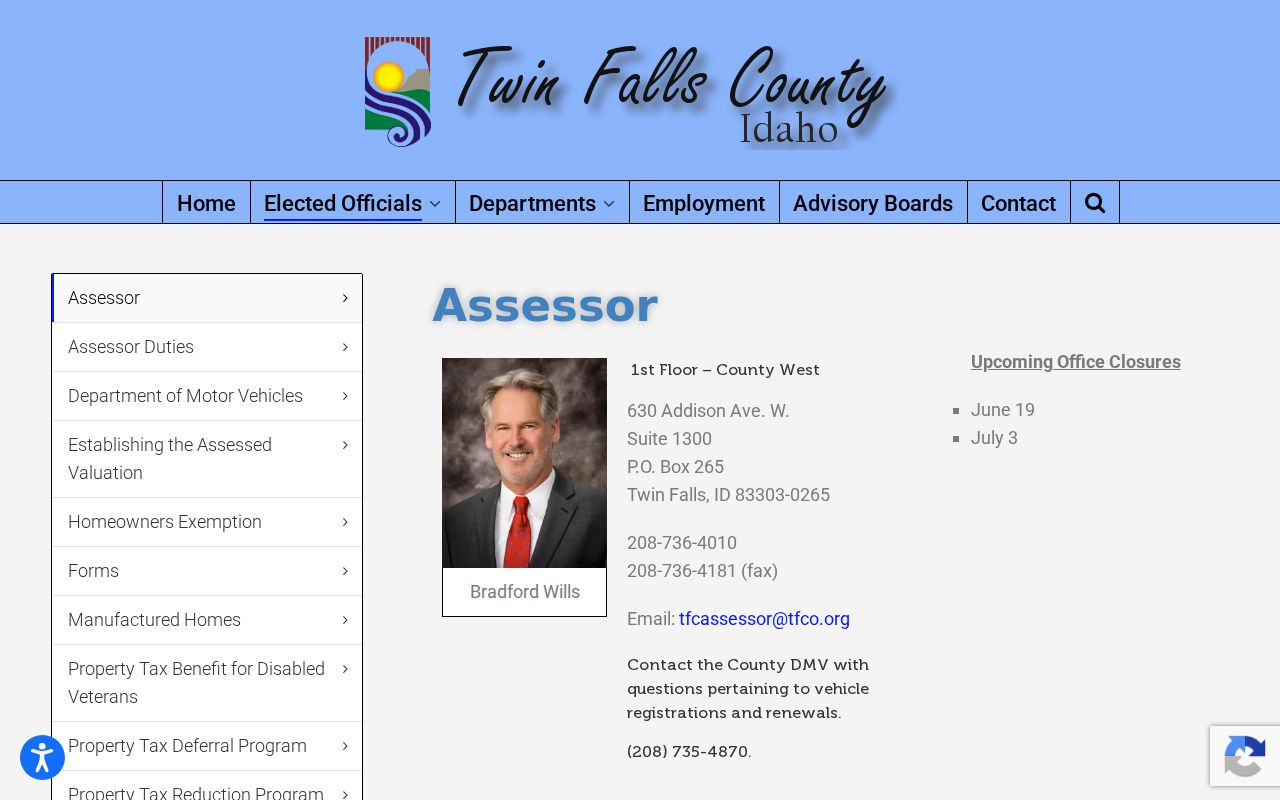
The image shows the official source, and the office's live record gives each parcel its dated value.
- Search the county ArcGIS address field and copy the full parcel ID.
- Ask the Assessor for the market or assessed value, taxable value, assessment year, and any land/improvement split available.
- Retrieve the latest recorded deed if transfer consideration matters.
- Classify the deed as a market or non-market transfer before treating its amount as a comparison.
- Assessed value
- The official value assigned through the assessment process.
- Market value
- The Assessor's estimate under Idaho's full-value standard.
- Assessment ratio
- Assessed value divided by verified sale price in a ratio study.
- Consideration
- Transfer language or amount in a deed, which may not be a market price.
- Reassessment
- A later valuation cycle or update that changes the dated roll amount.
Understand Idaho's 100 Percent Value Standard
The Idaho State Tax Commission treats the 100 percent assessment level as market value. Its sales-ratio studies compare county assessments against verified sale prices. A ratio above or below one signals how a class of assessed property measures. It measures against market evidence. But the study works across a group. It never inspects a roof. Interior condition, easements, water rights, and repairs stay outside the ratio. That is why a professional appraisal can differ from the roll.
Separate Twin Falls County Taxable Value From Market Value
Idaho's homeowner exemption can cut taxable value for an owner-occupied primary residence plus up to one acre. The reduction is 50 percent, capped at $125,000. It changes the tax base only. The Assessor's market estimate stays the same. Property Tax Reduction and disabled-veteran relief run as separate programs with their own applications and evidence. An exemption flag also does not prove the named owner still lives there; for bill mechanics and appeal steps, see the property tax records guide.
Read Twin Falls County Deed Consideration Carefully
A recorded deed may state consideration, yet the number can mislead. Gift deeds, family transfers, trustee or estate deeds, and tax deeds often show zero or ten dollars. Nominal amounts carry no market meaning. Read the deed type first. Check the parties' capacities before using any figure. The state ratio study uses verified sales and excludes non-market transfers, so "last consideration" and "last market sale" are never safe synonyms.
Note: Keep the recording date and assessment year beside each value so figures from different time periods are not compared as current.
Date the Twin Falls County Assessment Number
The Assessor publishes annual assessment notices with value-appeal guidance. County rules put assessment appeals due by the fourth Monday in June. The Treasurer's payment dates come later. A June value and a later bill need separate labels. A sale recorded after the assessment date may not change an already issued notice. Ask whether a later deed or parcel change is pending instead of assuming the displayed value reflects the newest event.
Do Not Mistake a Tax Rate for Twin Falls County Value
The Treasurer collects taxes and explains taxing districts. That office does not set the Assessor's property value. The county posts no tax bills online. Call 208-736-4008 or email the Treasurer for a copy, and treat Point & Pay as a payment channel rather than a value source. District layers can explain why nearby parcels carry different levy components. They cannot show that either parcel would sell for more.
Know What Twin Falls County Property Value Cannot Tell You
An assessment is a mass-appraisal figure. It serves administration and taxation. It is not a parcel-specific purchase appraisal, an engineering inspection, a title opinion, or proof of a surveyed boundary, and GIS data shifts as county records get updated.
Value is not price. A Twin Falls County assessed value is not what the property will sell for. Obtain a licensed appraisal for a parcel-specific opinion.
GIS parcel lines are reference mapping. They are not legal survey evidence. For a fuller picture, compare the dated roll, a qualified appraisal, verified market sales, and the property's actual condition.
Compare Twin Falls County Land and Improvement Components
Ask the Assessor for separate land and improvement figures. Record them with the same assessment year. The public parcel card may not display this split. New construction, demolition, parcel division, or a land-use change can hit each component at different stages of county processing. Never mix years. Adding land and improvement figures from one year to a total from another invites error. Preserve the roll date, parcel ID, and source label with every component, so a later reassessment stands apart from a transcription slip.
Classify Twin Falls County Sales Before Comparing Values
Any Twin Falls County sale figure needs context before it says anything about value. Was the sale arms-length? Did one deed cover multiple parcels? A trustee, an estate, a family member, a government entity, or a tax-deed transfer can each turn a recorded amount into poor evidence of market price. The same goes for nominal consideration and corrective instruments. Those belong on a separate shelf entirely.
Do Not Price Twin Falls County Land From a Tax-Deed Minimum
Twin Falls County handles delinquency differently than many places. After three years of unpaid real-property taxes, the county begins the tax-deed process, publishes notices, and holds an auction rather than selling tax-lien certificates. A published notice typically shows the parcel number, a prior owner of record, the property description, the address, and a minimum bid. Sales run as-is and final. Treat that minimum bid with care. It reflects a statutory process, not a market appraisal or a normal listing price for comparable Twin Falls County land. Before relying on any deed records from an auction, compare the parcel's condition, dig into title and access, and keep the tax-deed figure out of ordinary value comparisons unless its special status is clearly labeled.
Ask for a Reproducible Twin Falls County Value Record
A precise request gets a precise answer. When you contact the Twin Falls County Assessor, have the exact parcel number ready. Include the situs address, the owner of record if known, and the assessment year. Ask for the official value labels and the notice date. Request the land and improvement breakdown if the office maintains one. Also ask about any exemption effect. Check whether a parcel split, new deed, or construction change is pending. Updates do not always post immediately. For deed questions, the recorder is the right office. Provide party names, the parcel number, and the legal description. Add the document type and a recording-date range. The Treasurer handles the tax bill and payment amount separately. Keeping these roles straight prevents mislabeling. An assessed value, a taxable value, a tax payment, and a transfer figure stay distinct as separate property records.
Note: Cite both the source and valuation date whenever a Twin Falls County property value is shared or compared.