
Trace Twin Falls County Former Owners Transfer by Transfer
Build a backward table starting with the present recorded grantee. The county publishes no online deed-index form for the public. Get the latest instrument from recorder staff first. Then enter the historical collection with a solid anchor.
| Transfer date | Grantor to grantee | Instrument | Book/page or number |
|---|---|---|---|
| Newest first | Immediate prior owner to present grantee | Latest recorded deed | Copy from recorder |
| Next earlier | Earlier owner to that prior owner | Warranty, quitclaim, trustee, or other deed | Index reference |
| Estate interval | Decedent or representative to successor | Probate order and distribution deed | Court and recorder references |
| Subdivision origin | Developer or land company to first lot owner | Plat plus deed | Plat and deed-book references |
On every row, record the legal description, APN, all party capacities, and predecessor parcel numbers. That discipline matters. It keeps a same-name stranger or a later street address from dragging your chain onto the wrong parcel.
Reconstruct the Twin Falls County Deed Chain Backward
Reach the Clerk/Auditor/Recorder at 630 Addison Avenue West, second floor, or 208-736-4004. Staff work fastest with specifics. Give them the parcel ID, the exact legal description if known, current and former names, instrument type, date range, and whether a plain or certified copy is needed.
- Open the latest deed and identify the grantor who transferred to the present grantee.
- Search that grantor as a grantee in an earlier deed.
- Compare the legal description and prior reference before accepting the link.
- Repeat through direct and reverse indexes, then continue in physical books or archive images.
- Grantor
- The party who conveyed the interest.
- Grantee
- The party who received it.
- Chain of title
- The ordered sequence of conveyances affecting the land.
- Reverse index
- An index organized by grantee, useful for finding an owner's acquisition.
- Quitclaim and warranty
- Different deed forms; neither label alone proves the whole chain is clear.
Go Beyond the Twin Falls County Online Index Years
The Idaho, Twin Falls County Records, 1906-1988 collection extends well past the county's online index years. It holds direct and reverse deed indexes covering 1915 through 1974 and deed images from 1906 through 1941. The collection reports 43,094 records and 180,915 images. Those totals are large but no guarantee. Not every deed year is searchable.
Online cutoff. Verified deed indexes stop at 1974. Continue earlier or later former-owner work through the recorder, browse images, deed books, microfilm, and archives.
When a name search misses spelling variants, browse the image waypoints instead. The county recorder stays the official custodian of current recorded documents.
Follow Carey Act and Homestead Owners
Twin Falls County formed in 1907 amid irrigation-company townsite development and Carey Act settlement. The historical collection reflects that origin. It includes Carey Act land applications for 1903-1911, homestead declarations for 1901-1965, final certificates for 1906-1918, and state Carey Act patents for 1905-1950. These records explain an early chain that mixes irrigation applications, patents, and water-related evidence with ordinary deeds. Keep the project or land-company name beside the legal description. An archive request can then follow the same tract.
Bridge Twin Falls County Probate and Parcel Changes
A former-owner chain can break in many ways. Death, trust distribution, divorce, tax deed, foreclosure, correction deed, corporate name change, parcel split, road vacation, or annexation all interrupt a clean sequence. Search the decedent and personal representative in court and recorder records. Then hunt for the instrument that returned the land to a normal grantee chain. The FamilySearch estate index covers 1907 through 1980. The Idaho State Archives AR 207 catalog spans county-government series dated 1880 through 2018. It includes probate and treasurer material. Each series carries its own date range, so check before relying on coverage.
Resolve a Changed Twin Falls County Street Address
A deed's legal description outlasts any street number. One local photo record shows why. A building displayed 150 above its door. Directories for several years listed it as 132 Main Avenue South. That conflict is a cue, not an answer. Compare directories, the plat, the deed, and the parcel record. Do not trust the visible number alone. Twin Falls Public Library holds newspapers from 1904. Its microfilm runs through the present. The collection also includes local directories, maps, and a large Idaho Room. Its local-history page is the access point for these materials.
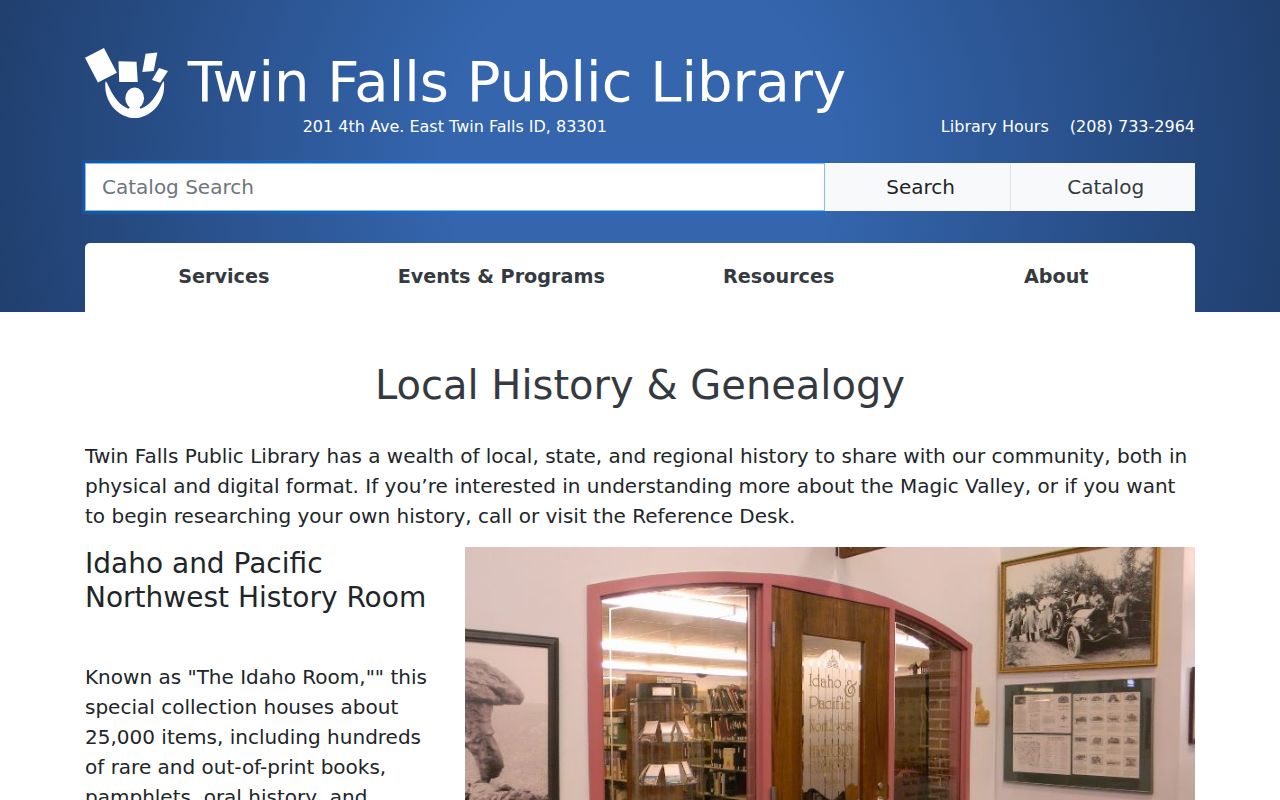
Staff research costs $5 per located newspaper article or obituary, and directory entries show occupancy clues rather than ownership proof.
Check Former Owners Against the 1967 Tax-Deed Error
A 1967 tax deed typed section 19 instead of section 16. The wrong parcel then appeared county-owned until a 2022 correction fixed it. The episode explains why a former-owner table must reconcile the APN, quarter-section description, and map position. It must also cover every earlier deed. If one link conflicts, stop the chain there. Seek a correction deed, resolution, or court record. Never force a name sequence across a different legal description.
Keep Twin Falls County Former Owners in Context
A deed names grantors and grantees. A directory or newspaper may name an occupant, business, or mailing address. Those roles differ. A former owner might also have held only a partial, life-estate, trustee, or representative interest in the property.
Use history lawfully. Former-owner research supports house history, estate work, and purchase diligence. Never use it to track or harass a living person.
For one instrument's fields and copy options, see the deed records guide. A complete title opinion requires more than this historical reconstruction.
Choose the Right Twin Falls County Historical Run
The county collection separates its series rather than covering every record from 1906 through 1988. Homestead declarations run 1901-1965, Carey Act applications 1903-1911, direct and reverse deed indexes 1915-1974, deed images 1906-1941, final certificates 1906-1918, final-proof indexes 1906-1950, state Carey Act patents 1905-1950, and estates 1907-1980.
Select the series by event and year. A patent or homestead record can precede the first private deed; an estate index can explain a missing owner-to-owner transfer; and a final plat can show when one parent tract became numbered lots.
Connect Twin Falls County Prior Owners to the Plat
City subdivision GIS can surface a recorded plat name. The county recorder can then supply the legally filed map and its deed references. That path helps most for a former owner's deed. It works when the deed uses lot and block rather than a modern street number. Rural chains run differently. They lean on Boise Meridian section, township, range, and metes-and-bounds descriptions. When a lot line changed, keep the parent tract together. Include the predecessor APN, adjustment or survey, and later child parcel. Searching only the current APN can hide earlier owners. Their deeds may have covered a larger piece of ground.
Use Every Twin Falls County History Access Channel
Take a layered approach. Begin at the Twin Falls County recorder counter. Staff there handle requests for official deeds, indexes, plats, and surveys. FamilySearch offers digitized images and waypoints. These cover the verified historic runs of Twin Falls County property records. Turn next to the Idaho State Archives, searching by series and date. The Twin Falls Public Library can then round things out with newspapers, directories, and maps for reconciling old addresses. No single channel holds everything, so each one fills gaps the others leave open.
When you write to an archive or library, be specific. Include every spelling of the owner's name and the exact legal description. Add both old and new addresses, the subdivision, the date range, and any instrument reference you already know. Ask up front what citation or copy format the institution can supply. A transcript is never a substitute for the official recorded deed.
Audit Each Twin Falls County Prior-Owner Link
Never trust a single index row. Confirm that the earlier grantee on a Twin Falls County deed is the same person who later signs as grantor. Check that both instruments describe the same parcel of land. Compare middle initials, spouse names, entity names, trustee capacities, signatures, and citations to prior instruments. Surnames repeat constantly here, so a shared last name proves little on its own.
Look beyond the names, too. Easements, reservations, life estates, and partial interests can survive a transfer. They may never appear in the recorded sequence. A deed chain that looks tidy may still hide a separate interest in the land. Former-owner research reconstructs the path of title. A professional title examination remains a separate and deeper task.
Preserve a Twin Falls County Former-Owner Research Log
Log every search as you go. For each attempt in Twin Falls County property records, note the source, the date, the name variant, the year span, the index direction, and the book or image reference, plus the APN and whether the legal description matched. Record your negative searches as well. Those dead ends keep you from repeating work, and they mark the spots where a chain shifted from online images into recorder books, probate files, or archive series.
Keep directory residents and newspaper names apart, in a clue column of their own. Only move a person onto the former-owner timeline once a deed, patent, tax deed, or other controlling land instrument ties that name to the parcel.