
Instruments Found with Twin Falls County Deed Records
The Clerk/Auditor/Recorder maintains Twin Falls County deed records alongside many other land instruments. A conveyance changes or claims an interest in real property. A deed of trust works differently. It secures an obligation rather than transferring ownership outright. Reconveyances and releases clear recorded burdens once the obligation ends, so the instrument type and its operative language matter more than the label on the entry. Treat each recorder filing on its own terms instead of assuming every document moves title.
| Instrument | What it does | Why researchers use it |
|---|---|---|
| Deed, grant, or conveyance | Transfers the interest described by the instrument | Connects grantor, grantee, and legal description |
| Quitclaim deed | Conveys whatever interest the signer has without a universal promise of title | Resolves or transfers a claimed interest |
| Trustee or estate deed | Transfers in a stated representative capacity | Explains a trust, probate, or authorized sale |
| Tax deed | Documents the county tax-deed process and resulting conveyance | Traces delinquent-property history |
| Trust deed or mortgage | Secures an obligation against real property | Identifies an encumbrance, not a new owner |
| Reconveyance or release | Releases the referenced security instrument or claim | Tests whether a burden was cleared |
Plats, surveys, easements, assignments, liens, lis pendens, powers of attorney, and manufactured-home real-property declarations can all join the same land trail in Twin Falls County. Each one matters. Tie every document back to the parcel number and the legal description to keep the chain coherent.
Twin Falls County’s Clerk Also Serves as Recorder
The Twin Falls County Clerk/Auditor/Recorder sits on the second floor at 630 Addison Avenue West in Twin Falls. The office is reachable at 208-736-4004. Idaho's constitution makes the district-court clerk ex-officio auditor and recorder. That one office therefore holds several distinct record roles. Ask for land-record or recorder assistance specifically when you need deeds.
The county publishes no clearly labeled public web grantor-grantee index. Online deed images, a document-type dropdown, and any search cutoff cannot be promised. Four access paths work well. These are the recorder counter, phone or email direction, a formal county public-record request, or an office-directed professional search. Each route leads to the same recorded instruments.
The county's official recorder page names the office and its record responsibilities.
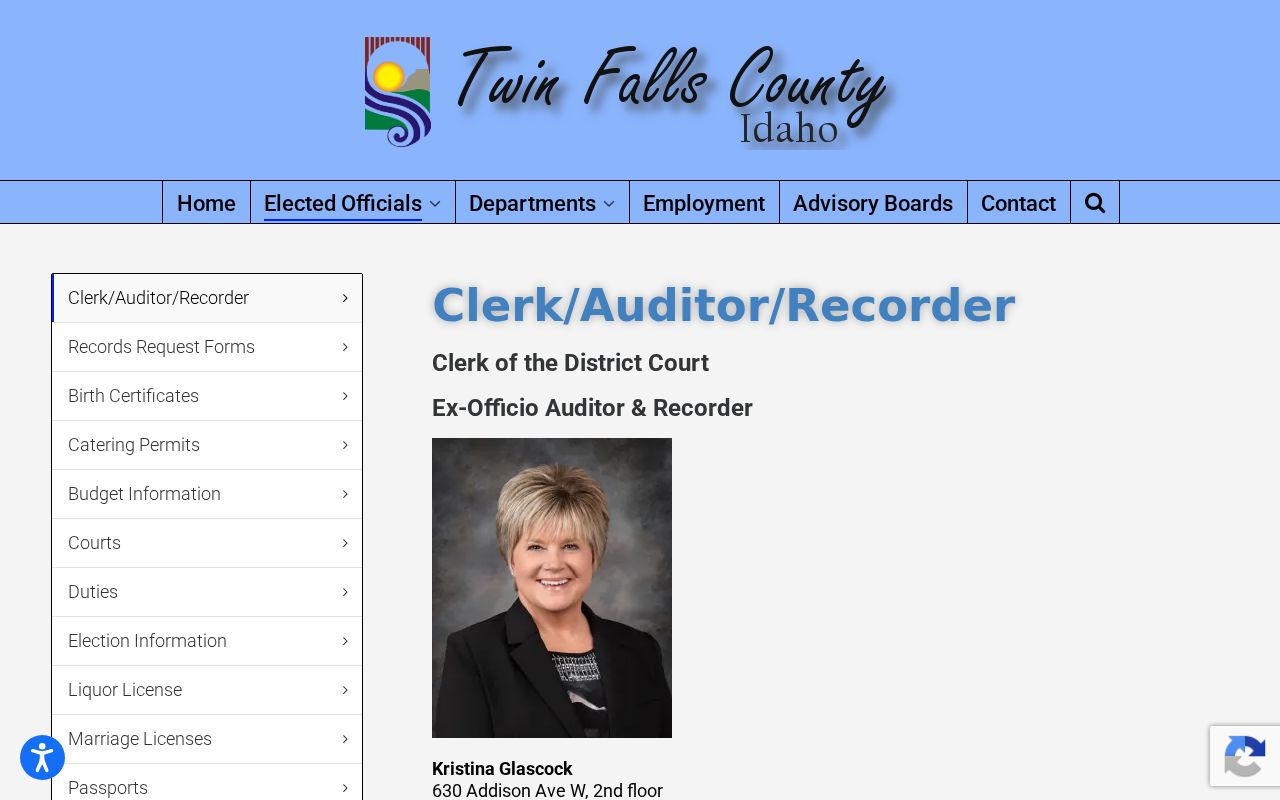
Staff can supply current search-interface details and copy instructions that the page does not publish. A quick call settles both.
Walk the Twin Falls County Grantor-Grantee Chain
A deed index runs on party names, while the land itself is anchored better by parcel number and legal description. Start with one acquisition document you trust, then alternate grantor and grantor down the chain of Twin Falls County transfers.
- Identify the present parcel, legal description, and known current grantee.
- Find that grantee’s acquisition deed and read the grantor, recording date, and reference.
- Search the grantor as an earlier grantee, using spouse, trustee, estate, and entity variants.
- Repeat backward, then move forward again from the oldest clear transfer to catch gaps.
- Match every deed to the same land and examine splits, combinations, easements, liens, and releases.
- Grantor
- The party transferring the stated interest.
- Grantee
- The party receiving the stated interest.
- Chain of title
- The connected sequence of instruments affecting the same land.
- Book/page or instrument number
- The recorder reference used to retrieve a document; ask staff which applies to the record.
Names alone will not carry the search. One owner may hold several parcels, an LLC may file under name variants, and an APN can change after a land division. The legal description inside each deed is what keeps the chain tied to the same ground.
The Verified Historical Run for Twin Falls County Deeds
FamilySearch's Idaho, Twin Falls County Records collection offers the clearest verified historical route into Twin Falls County deed records. Its direct and reverse deed indexes span 1915 through 1974. Deed images reach back further still. They cover 1906 through 1941. Across its wider county holdings, the collection reports 43,094 indexed records and 180,915 images.
| Historical series | Verified years | Search value |
|---|---|---|
| Direct deed index | 1915–1974 | Typically follows grantor entries |
| Reverse deed index | 1915–1974 | Typically follows grantee entries |
| Deed images | 1906–1941 | Supplies operative language and land description |
| Homestead declarations | 1901–1965 | Adds historical land evidence |
| Carey Act records | 1903–1950 across applications and related runs | Connects irrigation settlement to early land history |
Those years describe the digitized historical collection alone, not the full lifespan of county deed records or any current recorder-index cutoff. FamilySearch may apply account or image restrictions.
Carey Act Files Explain an Unusual Twin Falls County Land Trail
Land work in early Twin Falls County does not stop at the deed books. Settlement here ran through the Carey Act, and the paper trail shows it. The surviving files hold applications and patents. Materials from the Twin Falls Land and Water Company sit alongside irrigation evidence. A deed chain may therefore lean on water rights and land interests. A modern street address cannot explain those. That is normal for this county. Read the chain with the water record beside it.
The Idaho State Archives catalog lists a Twin Falls County government collection, AR 207. Its series span 1880 through 2018. Treat those endpoints as a rough frame only. Each series carries its own range, so match the folder to the era you need. FamilySearch and the archive work well as historical supplements. For current record status, the recorder still has the final word.
Note: Keep water-related reservations and easements in the inventory even when the ownership deed itself appears straightforward.
Published Recording Fees for Twin Falls County Instruments
The official recording-fee page lists the charges for filing an instrument with the county. Recording fees are one thing. Copy prices are another. The posted figures do not set the cost of plain or certified copies of deeds already on file, so ask recorder staff for the current charge before you order.
| Deed, grant, or conveyance | $15 for documents of 30 pages or fewer |
|---|---|
| Trust deed or mortgage | $45 for documents of 30 pages or fewer |
| Reconveyance or mortgage release | $15 for documents of 30 pages or fewer |
| Power of attorney | $25 for documents of 30 pages or fewer |
| Other or over-length instruments | $10 first page and $3 each additional page |
| Plat / survey | $11 per plat page / $5 per survey page |
Under Idaho Code §31-3205, the county sets its recording schedule, effective July 1, 2018. Confirm the fee for any unusual instrument before sending payment.
Request a Twin Falls County Deed Copy That Staff Can Find
A sharp request gives the recorder several ways to find the deed. Include the parcel or APN and the exact legal description if you have it. Add current and former owner names, the instrument type, and an approximate recording date. Say whether you want a plain or certified copy. Ask staff to check the grantor and grantee sides both. One side alone can miss the entry.
Start at the counter or contact the recorder directly. If staff point you to formal intake, use the county public-record request page. An Idaho Public Records Act request should describe an existing record and your preferred format. Copy or labor charges may apply under the statute. Avoid asking for everything at an address. Rural instruments often carry no street address at all. That makes this kind of request too broad to fill.
Once the image arrives, read it closely. Confirm the instrument number. Confirm the recording date and time. Confirm every grantor and grantee with capacity noted. Check the legal description and the APN if one appears. Look at consideration language, the notary acknowledgment, the return-to address, and any prior-instrument reference. Scan exhibits for easements or reservations. Then confirm signatures and recording stamps before you rely on the copy.
Read Liens and Releases Beside Twin Falls County Deeds
Deeds answer who owns. Liens answer who has a claim. The recorder's index in Twin Falls County traces both, so run names of the parties and the land description against deeds of trust, assignments, reconveyances, mechanic's liens, easements, judgments, lis pendens, releases, and tax deeds. Read releases carefully. One release may clear a single obligation or a single parcel, so match it to the instrument it references before assuming a lien is gone.
For deeper context, district-court files can show foreclosure, quiet-title, partition, probate, or lien-enforcement actions behind a recorded document. Search case records through Idaho iCourt. Complete public files require the courthouse kiosk or a request to the clerk. Check whether the judgment, order, lis pendens, satisfaction, or resulting deed was also recorded with the county.
UCC fixture filings sit outside this trail. They cover goods attached to land but live in a separate SOSBiz search, and that query alone is no substitute for a full land-title examination of the property records.
City Plat Approval Still Ends in County Recording
Twin Falls, Kimberly, and Buhl each review subdivisions and plats under their own planning rules. Final plats, though, are filed with the Twin Falls County recorder. The split matters. City approval captures the land-use decision; the recorded plat creates the county land-record reference you cite in a deed records search.
For a subdivided parcel, pull together the city case number, project name, parcel number, conditions, final decision, and plat. Then confirm recording with the county. A conveyance plat can show land intended for sale without serving as development approval, so keep the planning stage and the recording stage distinct.
This geography also helps with older deeds. Many describe land by addition, lot, and block rather than a modern street address, and the plat connects that language to a parcel on the ground.
What Twin Falls County Deed Records Do Not Settle
Recording a deed gives public notice of the instrument that was submitted. It guarantees nothing more. The Twin Falls County recorder does not promise that every claimed interest was ever recorded. Nor does the office promise that signatures or authority will hold up against a challenge. And no index entry proves the document applies to the parcel you have in mind. Tax deeds add their own cautions. They often carry as-is and title-risk warnings, and the county states plainly that Idaho does not sell tax-lien certificates.
Recorded is not guaranteed. Twin Falls County deed records are evidence in a title investigation, not a title opinion. Resolve competing interests or uncertain legal descriptions with a qualified Idaho professional.
Twin Falls County offers no property-fraud alert subscription. Do not rely on a neighboring county's service as a stand-in. Owners worried about an unfamiliar filing should contact the recorder and use current official channels.