
Search Twin Falls County Records
Twin Falls County spreads its property records across several desks. The Clerk/Auditor/Recorder, Assessor, Treasurer, courts, planning offices, and GIS systems each hold one piece. Start with the fact already in hand. A street address fits the county parcel map best, while a parcel number, or APN, gives every office a stable key. Party names help the recorder search deed records. The county website exposes no public grantor-grantee form, though. So go map first, confirm with the office second, and pull recorded instruments third.
Each source answers a different question. The map ties an address to its parcel. The Assessor lists and values taxable property, while the recorder keeps deeds, mortgages, releases, plats, and surveys. The Treasurer bills and collects. None of that alone proves clear title or a surveyed boundary.
- Enter the site address in the Twin Falls County parcel map.
- Copy the selected parcel's APN and confirm the current roll details with the Assessor.
- Give the recorder the APN, names, legal description, instrument type, and likely recording years.
- Ask the Treasurer for the actual bill when tax amounts or payment status matter.
- Order a plain or certified copy from the custodian and compare every date and legal description.
Twin Falls County Records Offices
Three offices divide the core work. The Clerk of the District Court doubles as ex-officio Auditor and Recorder, and its second-floor counter receives and copies land instruments. The Assessor discovers, lists, and values taxable property. It sets no rates and collects no bills. The Treasurer handles property tax and answers bill questions in Twin Falls County. All three sit at the county complex on Addison Avenue West, and court-file copies go through the clerk or the courthouse public-access kiosk rather than the land-record route.
Clerk/Auditor/Recorder
630 Addison Ave W, 2nd floor
Twin Falls, ID 83303
208-736-4004
Twin Falls County Assessor
630 Addison Ave W, Suite 1300
Twin Falls, ID 83303-0265
208-736-4010
Twin Falls County Treasurer
630 Addison Ave W
Twin Falls, ID 83303
208-736-4008
Twin Falls Parcel Search Keys
The official ArcGIS experience is the county's clearest public start for a parcel search. Its address field is named PM_PROP_AD. Its parcel field is PARCEL_ID. Both accept partial text, and results cap at six. The app can select the first matching parcel on the map, so if a full address fails, try the bare street name or switch to the APN for later searches.
| Known clue | First search | Carry forward |
|---|---|---|
| Site address | County ArcGIS address field | Parcel ID and mapped location |
| Parcel/APN | County ArcGIS parcel field | Exact ID, legal-description clues |
| Owner name | Assessor staff and recorder indexes | Instrument number, book/page, deed date |
Some APNs in Twin Falls County carry prefixes and suffixes like RPT, RPK, RPB, RPM, OC, O1, PP, and T1. Keep every character. A shortened number can point to no parcel at all. It can also lead to the wrong record family.
Address, situs, and mailing fields are not interchangeable. The situs address describes the mapped site. A mailing address is where notices go, and it may sit outside Idaho. A legal description identifies land through lot and block, subdivision, or section-township-range terms. When names or addresses conflict, preserve each version in the request. The parcel key is the cleanest bridge between formats.
Twin Falls GIS Layers
The county web-map configuration documents more than parcel outlines. Imagery, taxing districts, Public Land Survey System grids, wells, water-right places of use, and surface-management lands all appear as context. The viewer also offers zoom, locate, layer, basemap, measure, select, legend, and full-screen tools. Those layers explain rural land, irrigation, and jurisdiction, but they create no legal right.
A well point does not prove well ownership. A water-use overlay does not settle priority. Parcel lines are tax mapping, not a survey. Use the map to find the APN and its geography, then consult recorded easements and a licensed surveyor when legal boundaries matter.
For a first pass, the official Twin Falls County parcel experience page displays the county's interactive viewer. It pairs the parcel search with these same layers.
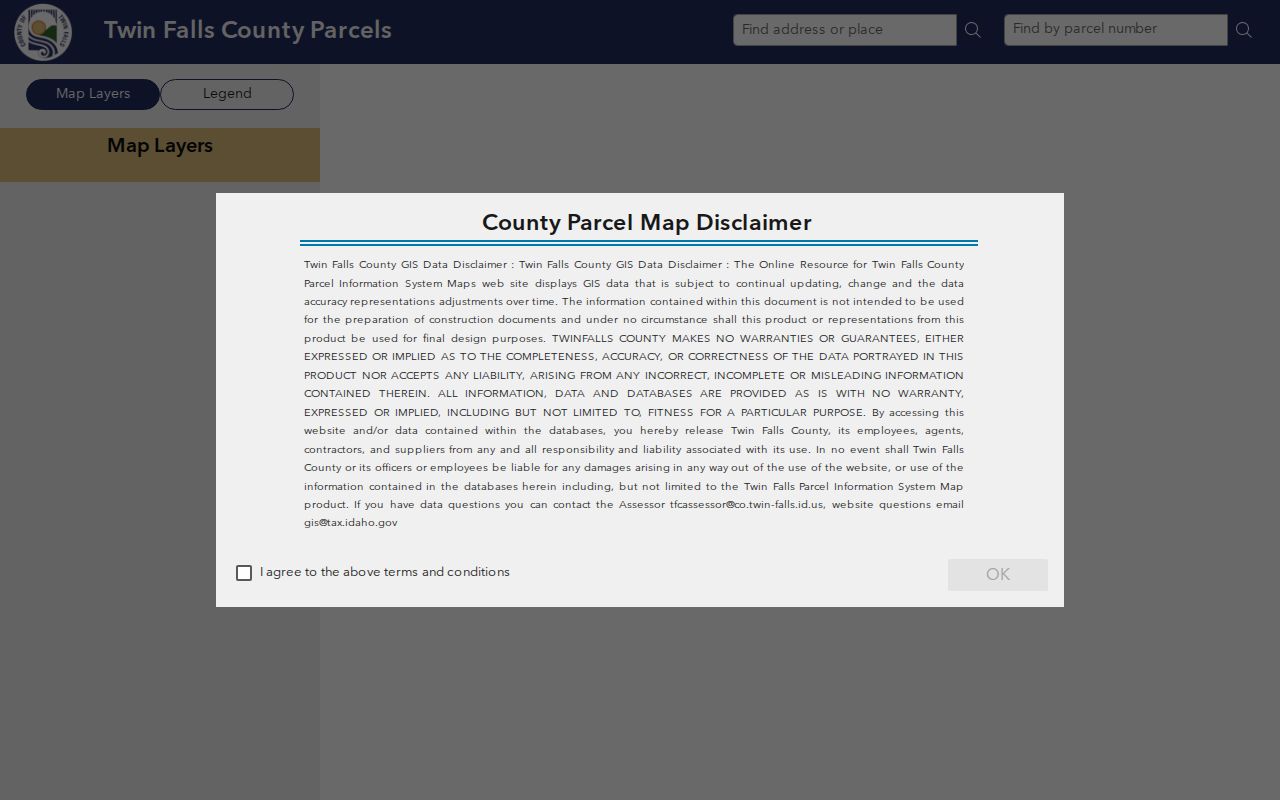
Treat the selected parcel and copied APN as clues. Verify the record with the Twin Falls County office responsible for it.
Twin Falls Deeds Offline
The county site offers no public deed-index form. Deed records therefore live at the Clerk/Auditor/Recorder counter or through a direct records request. Give staff the complete APN. Add the exact legal description when known. Include current and former names, instrument type, estimated date range, and the kind of copy needed. Ask for searches in both the grantor and grantee indexes, since a grantor transfers an interest while a grantee receives one.
Never ask only for everything on one address. Rural deeds may omit a street address, one owner may hold several parcels, and a court case may mention a document that was never recorded. A focused request helps staff distinguish an indexed instrument, a court-file reference, and no responsive record. A narrow ask saves everyone time.
Historic Twin Falls Deed Images
For older deed records, the strongest online option is FamilySearch's Idaho, Twin Falls County Records, 1906-1988 collection. The catalog reports 43,094 records and 180,915 images, though those totals span several record groups. Direct and reverse deed indexes cover 1915 through 1974. Deed images themselves run only from 1906 through 1941. So treat the set as a partial substitute, not a full land-record archive for every year through 1988.
Indexed names can miss handwritten or oddly spelled entries. Browse the image waypoints and try spelling variants. The historical collection works well as a finding aid and copy source. The county recorder stays the official custodian of current records.
Read both index directions before opening images. A direct index lists grantors. A reverse index lists grantees. Jot down the book, page, instrument date, filing date, and party spelling first. Then work through every exhibit and continuation page for easements, reservations, prior-instrument references, notary details, and the full legal description. A short index row rarely carries the terms that control the transfer.
Twin Falls Property Record Types
No single file ever tells a property's whole story. Recorded deeds document transfers and legal descriptions. Mortgages, deeds of trust, releases, judgments, and lis pendens can surface recorded claims. Some can also signal pending litigation. Assessment records tie a parcel to taxable value. The Treasurer keeps the tax bill and its payment status. Plats and parcel maps supply lot, block, subdivision, and wider land-grid context. Planning files at the city and county add permits and zoning decisions. They also cover lot splits, annexations, and public-hearing material.
| Record Type | What It Documents | Kept By | Access |
|---|---|---|---|
| Deeds | Transfers, parties, legal description | Clerk/Auditor/Recorder | Counter or request; historic images online |
| Mortgages and liens | Recorded loans, releases, claims | Recorder and courts | Recorder request and iCourt lead |
| Assessment and tax | Value, exemptions, bill, delinquency | Assessor and Treasurer | Parcel map plus direct office contact |
| Plats and parcels | Lot, block, APN, mapped context | Recorder, GIS, planning | Free viewers and recorded copies |
| Building and land use | Permits, zoning, annexation, approvals | County or city planning | Portal, posted files, email, or counter |
Follow legal ownership through Twin Falls County deed records. Turn to property tax records for assessment, relief, bills, and delinquency. A permit or map explains physical change but never replaces the recorded deed.
Liens split across systems too. Mortgages, deeds of trust, releases, and some claims get recorded. Judgments, foreclosure pleadings, quiet-title actions, and probate orders start in court. Business-collateral UCC filings live in Idaho SOSBiz. Search whichever system creates the record. Then see whether the result was also recorded against the land. A matching name is only a lead until the parcel and legal description agree.
Twin Falls Recording Fees
The county's published fee list prices instruments separately rather than quoting one flat charge. Deeds cost $15. Trust deeds and mortgages run $45. Reconveyances and releases are $15, and powers of attorney are $25. Plats cost $11 per page and surveys $5 per page. The list does not publish every copy, certification, or mailing charge, so confirm the current total with the clerk before recording or ordering.
Plain or certified? A readable research copy may be enough for comparison. Ask for a certified copy when an agency, court, lender, or legal process requires the custodian's certification.
Copy fees are not recording fees. The public list prices common recording work. It does not cover every search, page, certification, archive scan, or mailed response. Ask the clerk for an estimate up front. Under the Idaho Public Records Act, custodians may charge allowed copying costs. They may also charge labor costs in qualifying cases. Keeping a request to a focused date span can make it clearer and cheaper.
Twin Falls Values and Taxes
Idaho assesses property at market value. The State Tax Commission treats a 100 percent assessment level as market value and uses ratio studies to compare assessed values against verified sales. A homeowner exemption cuts taxable value for a qualifying owner-occupied primary residence plus up to one acre. It does not rewrite the assessor's market estimate. Nor does it prove the named owner still lives there.
The Assessor mails value notices and runs the June appeal path. The Treasurer later collects the tax bills. Those are separate dates and separate records. A sale recorded after the assessment date may not change a bill already issued. Weigh the assessment year, notice date, recording date, and tax year together before calling any amount current. The official property-value appeal instructions lay out the county's challenge route.
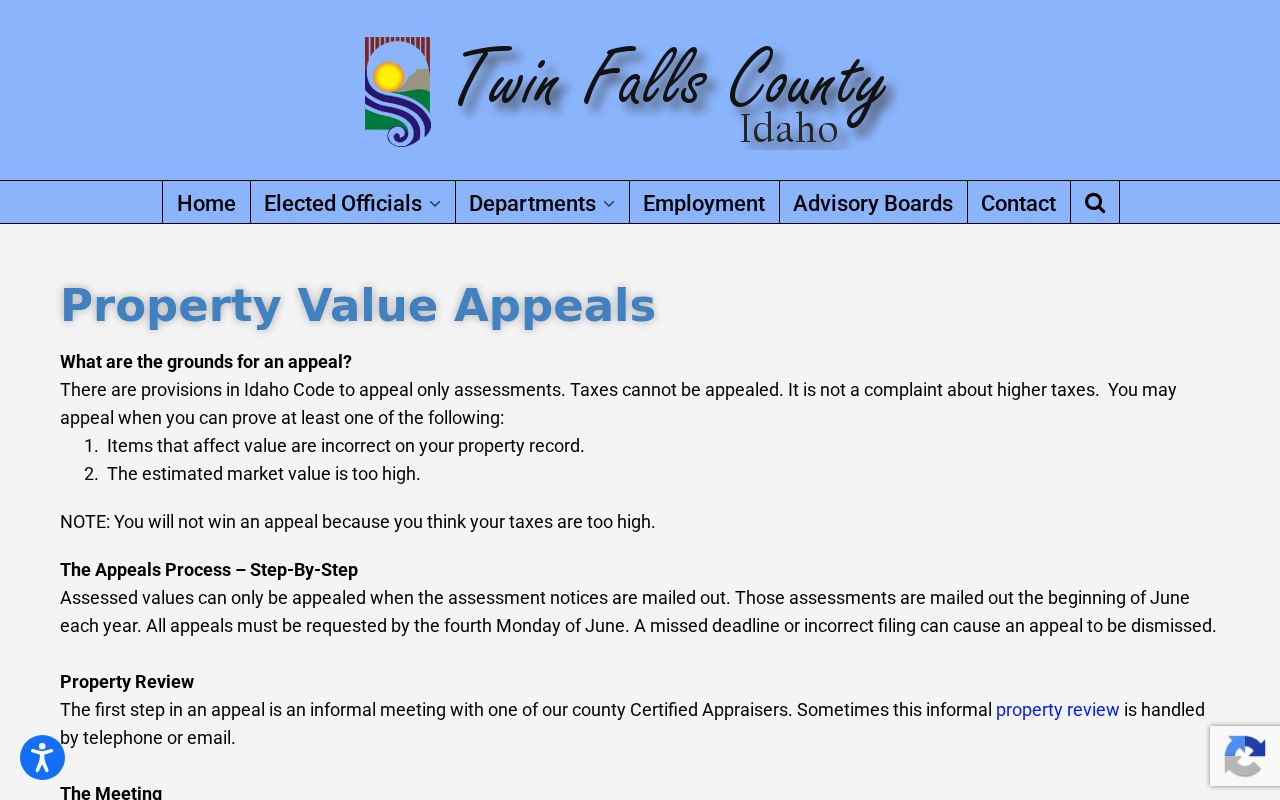
Rely on the current notice for the filing window and evidence requirements. Do not count on a prior year's dates.
Property Tax Reduction is separate from the homeowner exemption. It needs an annual application under its own status and income rules. Disabled-veteran relief follows yet another application path. A trust, recent purchase, change of residence, or stay in a care facility can all affect exemption treatment. Ask the Assessor which filing applies and what proof is required. Do not assume an older exemption continues on its own.
Twin Falls Tax Bills Stay Offline
Tax amounts and bill copies never appear on the county website. That work stays with the Treasurer. Call 208-736-4008 or use the email listed on the Treasurer page. Point & Pay handles payments, not public bill searching. Before calling, gather the 10-digit parcel or bill number. Ask for the year, the balance, the due date, and any delinquency status.
Idaho sells no tax-lien certificates. Instead, Twin Falls County starts a tax-deed process once real property runs delinquent for three years, publishes notice, and offers the parcel at a final as-is auction. Unpaid tax remains a perpetual first-priority lien. A tax-deed notice is useful evidence of a change. It is no warranty of condition, access, acreage, or clear title.
Regular property tax is due in full by December 20, or in two equal halves with the second half due June 20 of the following year. Mail can take five to ten days. Missing a notice never excuses interest or late charges. New construction may bring a later sub-roll bill for improvements. Separate parcels can generate separate bills, so confirm each parcel number instead of trusting one street address.
Twin Falls Court Record Leads
Foreclosures, quiet-title suits, probate, and lien disputes leave traces at both the courthouse and the recorder's office. Public case information starts with Idaho iCourt, but the documents themselves come from the courthouse public-access kiosk or the clerk where the case was filed. A new statewide kiosk interface arrived August 4, 2026. Older screen directions may not match.
Search by case number and party name. Then compare the docket to recorded instruments. A docket lists court events, and it can point to a judgment, an order, a probate appointment, or a foreclosure filing. Court involvement alone does not prove an instrument was recorded against the parcel, so ask the recorder to confirm the land-record index separately.
Probate can break a clean seller-to-buyer chain. A personal representative, trustee, surviving spouse, or court order may stand in for the person remembered at the property. Foreclosure can produce a sheriff's deed or a later conveyance. A quiet-title order settles competing descriptions. Request the operative court document first. Look for any deed or notice recorded after it. Names, cause numbers, instrument numbers, and legal descriptions should line up as one traceable sequence.
Twin Falls Plats Cross Offices
City planning bodies review subdivisions, annexations, and lot-line work. Development applications start there too, but the final plat gets filed with the Twin Falls County recorder. A plat is the recorded drawing that lays out lots, blocks, roads, and easements. The Twin Falls city GIS service covers Original Townsite, Canyon Falls, River Vista, Westpark, Villa Vista, Walden, and Wild Rose. Kimberly records name Patterson Farms and Good Neighbor. Buhl materials list Leo's Paradise and Harvest Hills.
That split matters. Ask the city about zoning, permits, and approval conditions. Ask the recorder for the filed plat and instruments. The county's area-of-impact maps help route land near a city edge, but the parcel map and recorded legal description should decide which file to request.
Twin Falls city publishes annexation, plat-vacation, planned-unit-development, rezone, variance, special-use, property-verification, and zoning-use forms. Kimberly takes detailed written land-use requests and warns that some research can take up to ten working days. Buhl accepts applications by email or in person and posts typical residential and commercial review ranges. These routes differ. A generic "permit search" will miss useful local files.
Twin Falls History Sources
The Twin Falls Public Library Idaho Room holds roughly 25,000 local-history items. The collection includes photographs, newspapers from 1904 forward, microfilm, and directories. Staff will locate a newspaper article or obituary for $5 per item. Pair a surname with "deed" or "estate." Pair a street with "subdivision." Pair a subdivision name with "plat." Always verify OCR hits against the page image. Old type and damaged film create false matches.
Early property trails can also lead to Carey Act records. The Twin Falls Land and Water Company left land evidence too. Irrigation applications, patents, and water-related land evidence explain transfers. No modern address search will find these. When the online deed run ends, the library's local history service, Idaho State Archives, recorder deed books, and federal land records form the fallback chain.
The Idaho State Archives catalog describes Twin Falls County government collection AR 207. Its series run from 1880 through 2018. Coverage varies by series. Use the catalog entry to pin down the record group and date before requesting material. Newspapers can bridge missing addresses, road vacations, estates, tax deeds, and subdivision names. Directories show how a building was known in its era. Even directories disagree.
Twin Falls Records Have Limits
Public property records carry real weight. A parcel lookup can surface the named taxpayer and the recorded grantee. It can also show the assessed value and the current tax status. Deed records show which instruments the recorder accepted. Plat maps, permits, court files, and historic context often sit nearby. Still, limits matter. A record cannot prove who occupies a home. A similar name is not always the right person. Unrecorded claims stay invisible. A tax mailing address is a notice destination, not an invitation to contact someone.
One 1967 tax deed shows why cross-checking earns its keep. A typo changed section 16 to section 19. So the wrong parcel looked county-owned until a 2022 correction fixed it. Match the parcel number against the legal description and the map position. Then follow the full ownership chain. When those disagree, stop. Ask the custodian for the instrument and its correction history.
The same caution extends to commercial property-data products. They work fine for quick discovery. But their update dates, sources, and matching logic can be murky. Official county records name an accountable custodian and offer a correction route. Even an official map has limits of its own. Treat an aggregator as a clue. Never treat it as the final source for a purchase or an estate. It should not settle a tax appeal, an easement question, or an ownership dispute either.
Use records lawfully. Idaho records support purchase research, boundary questions, estate work, tax appeals, and civic oversight. They do not replace a title company, attorney, appraisal, or licensed boundary survey. Never use an owner's information to stalk, harass, threaten, or cause harm.