
What Twin Falls County Property Tax Records Separate
Office responsibility draws the first line. The Assessor discovers, lists, and values taxable property. Yet it sets no tax rates and quotes no final bill. The Treasurer collects the property tax, fields bill questions, and pursues delinquency. Read values, relief, levies, and payment records together. But never treat one as a stand-in for the rest.
| Record field | What it answers | Official source |
|---|---|---|
| Market-value assessment | County mass-appraisal estimate before exemptions | Twin Falls County Assessor |
| Taxable value | Value remaining after applicable exemptions | Assessor and assessment notice |
| Exemption or reduction | Approved relief affecting taxable value or tax | Assessor |
| District levies | Rates contributed by local taxing districts | Treasurer tax bill |
| Amount and payment status | What is due, paid, late, or delinquent | Treasurer |
| Tax-deed status | Whether a three-year delinquency has reached formal action | Treasurer, published notice, and recorder |
A recorded sale amount is a separate category yet again. It can be nominal or otherwise non-market, while the assessment is a mass-appraisal value and the bill applies levy rates to taxable value.
Twin Falls County Assessed Value Follows Idaho’s Market Standard
Under Idaho State Tax Commission rules, property is assessed at 100 percent of market value. Exemptions then reduce that figure for taxable-value purposes. The ratio-study method compares assessed value against verified sale prices. An assessment level of 100 percent serves as the market-value proxy. None of that makes a county appraisal a listing price. It is not a sale forecast or a fee appraisal either. Mass appraisal values many parcels as of one assessment date. A later sale may not change a bill. That bill was already built on the earlier assessment cycle.
- Assessed or market value
- The assessor’s mass-appraisal estimate under Idaho’s standard.
- Taxable value
- The assessed amount remaining after approved exemptions.
- Levy or tax rate
- The combined rates used with taxable value to calculate the bill.
- Tax lien
- The county’s claim arising from unpaid property tax.
Request a Twin Falls County Property Tax Bill
The Twin Falls County Treasurer states plainly that tax amounts and bill copies are not posted on the website. Call 208-736-4008 or use the published county email instead. The online Point & Pay service handles payment once the amount and parcel or bill number are known. It is not a tax-roll lookup.
- Use the county parcel map to identify the correct parcel number from the address.
- Ask the Assessor to confirm the assessment year, value, and exemptions.
- Contact the Treasurer with the parcel number for the bill, district levies, and status.
- Compare due dates, payments, and any late charge or delinquency with proof of payment.
- If delinquent, ask whether the parcel has entered the formal tax-deed calendar.
The payment form asks for payment type, parcel number, amount, payer contact details, and payment method. It returns a confirmation number and printable receipt. Published convenience fees are $3.95 for debit, 2.5 percent for credit, and $2 for e-check.
Note: Keep the confirmation and independent proof of payment; Idaho law places that responsibility on the taxpayer.
Why Twin Falls County Tax Bills Remain an Offline Lookup
No online bill search does not mean no public record. It simply changes the access channel. Treasurer staff can supply the bill by phone or email, and a formal request for an existing document can go through the county public-record request. Check the official treasurer page for current contact details and deadlines.
One distinction shapes the county workflow: online payment begins after discovery. It does not replace the assessor and treasurer inquiry needed to identify the correct bill. When filing a records request, list the parcel number, property address, tax year, owner name as shown on the notice, and preferred format. Ask separately for historical bills or delinquency notices. Current and archived material can follow different retrieval paths.
Read the Taxing Districts on a Twin Falls County Bill
A single Twin Falls County property tax bill can bundle county, city, school, College of Southern Idaho, highway, fire, special-district, ambulance, and abatement levies. Which appear depends on parcel geography. The tax amount is the combined rate applied to taxable value. It is not a rate the Assessor chose. That explains how two properties with similar assessed values carry different tax amounts. Confirm each parcel's taxing-district assignment in the bill itself. Use the county GIS district layers as geographic context rather than a stand-in for the issued tax record. Do not substitute a sale price into the formula. Idaho ratio studies rely on verified sales to test assessment levels. Gift, family, trustee, estate, tax-deed, and nominal-consideration transfers may not reflect market transactions at all.
Twin Falls County Relief Programs Use Different Tests and Dates
The Twin Falls County Assessor page splits relief into three tracks: the homeowner exemption, property tax reduction, and disabled-veteran relief. The homeowner exemption lowers taxable value for an owner-occupied primary residence plus up to one acre. It does not prove the named owner of record still lives there.
| Program or action | Published 2026 timing | Important distinction |
|---|---|---|
| Homeowner exemption | Application received by December 31, 2026 for the stated 2026 reduction | Reduces taxable value; eligibility depends on primary-residence facts |
| Property Tax Reduction | January 1–April 15, 2026 | Separate annual income/status program |
| Disabled-veteran relief | January 1–April 15, 2026 | Separate program with supporting evidence |
| Value appeal | By 5 p.m. June 22, 2026 | Challenges assessed value through the annual board cycle |
Note: These dates are time-sensitive, so recheck the official page for the applicable year rather than reusing a prior calendar.
Contest a Twin Falls County Property Tax Assessment
Assessment notices go out near the start of June. Idaho's statutory appeal deadline lands on the fourth Monday in June. For the documented 2026 cycle, Twin Falls County set 5 p.m. on June 22. Start with the assessor to understand the parcel data and valuation. File the appeal with the Board of Equalization after that review. The strongest submission names the parcel and assessment year. It corrects factual errors. It also brings comparable or other market evidence tied to the valuation date. Keep sale evidence apart from nominal or non-market transfers. The assessor handles valuation. A fight over the issued bill or a payment belongs with the treasurer.
Appeal window. The published 2026 Twin Falls County deadline was June 22 at 5 p.m. Confirm the current year’s fourth-Monday deadline and filing requirements before acting.
The county value-appeals page documents the process.
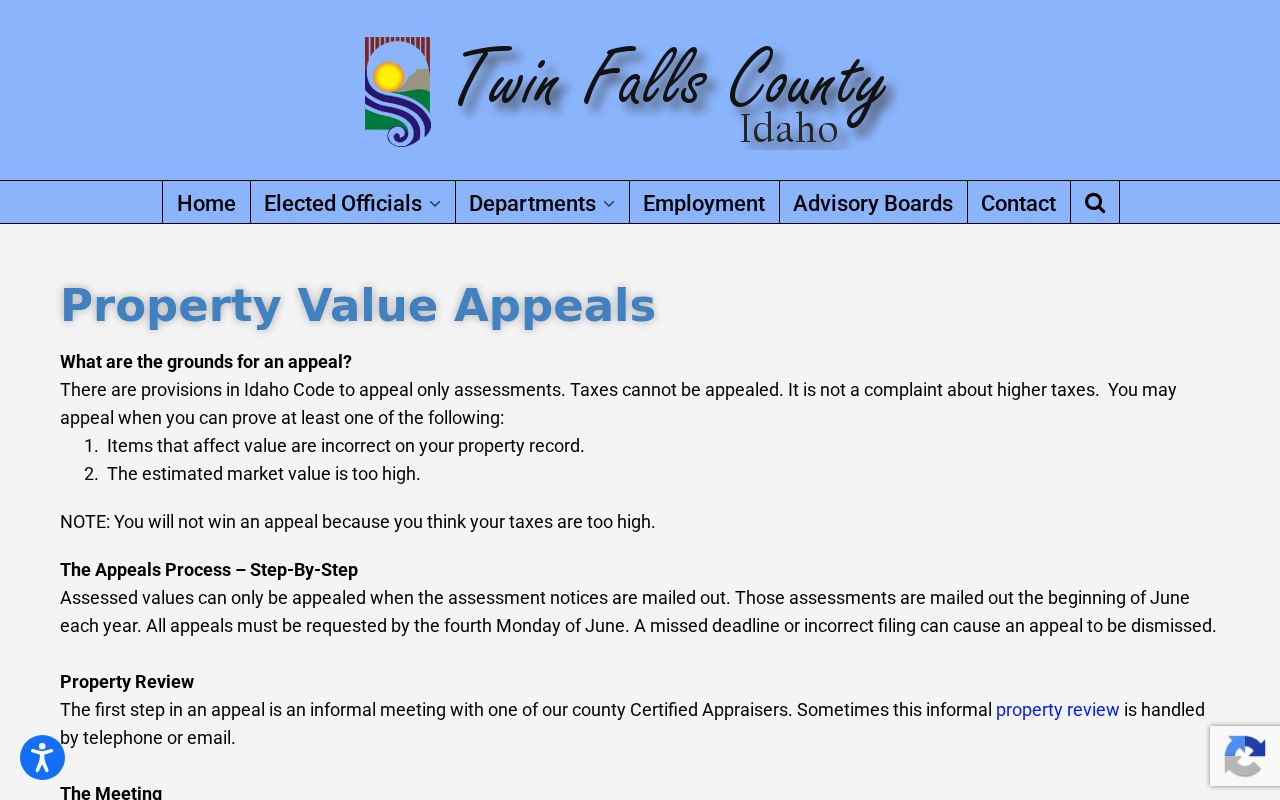
Treat the county page as the live source. It carries the current appeal form, deadline, office route, and supporting requirements.
Special Twin Falls County Property Tax Bill Prefixes
Some Twin Falls County tax bills carry a prefix. It tells you what kind of record you hold. A real-property bill is the standard case, and new construction gets billed differently. Improvements that gain value once occupied can appear on a subsequent-occupancy sub roll. Their parcel numbers start OC or O1. Business personal property shows up under PP, and transient property under T1. These prefixes are routing clues rather than full legal classifications. Ask the assessor or treasurer when a particular bill needs interpreting.
One property can also produce several bills. Separate parcels generate separate tax records. An owner may still treat the site as a single whole. Match each parcel number, year, land and improvement component, and payment on its own terms. A payment credited to the wrong parcel number can leave the intended bill showing as delinquent.
Three Years of Delinquency Can Lead to a Twin Falls Tax Deed
The Twin Falls County tax-deed process starts from a perpetual first-priority lien. It turns on three years of real-property delinquency. The published calendar moves through list creation and warnings. It continues with certified notice, newspaper publication, compliance affidavits, a hearing, and finally the deed recording.
Paying the third-year delinquency in full is what stops the action. Partial payments may be accepted. Yet they do not stop it unless the oldest required delinquency is satisfied. After April 1, the county's published procedure requires guaranteed funds.
| Early August | Delinquency list and party identification begin |
|---|---|
| August–October | Warning and reminder stages |
| January | Certified notice |
| March–April | Times-News publication and compliance affidavits |
| May | Tax-deed hearing and recording stage |
Idaho sells no tax-lien certificates. A tax-deed auction is an as-is sale, and the minimum bid reflects neither market value, assessed value, nor a guaranteed measure of the debt owed.
Dates That Change the Meaning of Twin Falls County Tax Records
Dates change what a Twin Falls County tax record is actually telling you. A June assessment notice, a December installment, the next June installment, and a later recorded sale each describe a different moment. First-half property taxes are due December 20. The second half is due June 20 of the following year. Taxpayers can instead pay the full bill by December 20. The county advises allowing five to ten days for mailed payments.
Not receiving a notice excuses nothing. Late charges and interest still apply under Idaho Code §63-902(9). Keep proof of payment, and confirm any change of mailing address went through the assessor.
A new deed recorded after the assessment date may not change a bill already issued. Read the labeled assessment year, tax year, recording date, and payment date before calling any amount current.